
Original Research · Frontiers in Toxicology · Published 27 March 2026
Building Australia’s Non-Animal Technologies Ecosystem: A National Cross-Sector Mapping and Strategic Insights from the Non-Animal Technologies Network (NAT-Net)
Shafagh A. Waters, Adam P. Hill, Esther S. Pronker, Gerard E. Kaiko, Gungun Lin, Simon Keely, Laura Collie, Wojciech Chrzanowski and Anai Gonzalez-CorderoNon-Animal Technologies Network (NAT-Net), University of New South Wales, Sydney, NSW, Australia · DOI: 10.3389/ftox.2026.1790806
Abstract
Background: Non-animal technologies (NATs), also called new approach methodologies (NAMs), are changing biomedical research, safety testing and drug development by improving human relevance and reducing reliance on animal models. Australia has substantial expertise across organoids, microphysiological systems and in silico approaches, but national visibility of capabilities, infrastructure access and system-level needs has been limited.
Methods: A cross-sectional, online baseline survey (February to October 2025) was integrated into NAT-Net registration and run using REDCap. It captured organisational characteristics, roles within the NAT ecosystem, research domains, model types, development stage, supporting services and infrastructure access, engagement preferences, and perceived challenges. Quantitative data were summarised descriptively, and free-text responses were analysed thematically.
Results: Of 135 submitted records, 124 unique respondents remained after removing incomplete entries and duplicates. Respondents were mostly based in New South Wales (71.0%), followed by Victoria (18.5%) and Queensland (7.3%). Most organisations reported involvement in research and development (79.0%), education and training (41.9%), ethics and the 3Rs (39.5%), and supporting services or facilities (32.3%). Among respondents engaged in NAT R&D (n = 102), common approaches included in vitro 3D models (64.7%), in vitro 2D culture (56.9%), microphysiological systems or organ-on-chip platforms (35.3%), and in silico methods (30.4%). Among service providers who answered the access question (n = 40), 60.0% offered external access. The most frequent challenges were the absence of standards and validation processes (75.8%), limited access to resources and infrastructure (74.2%), and difficulty forming collaborations or partnerships (71.7%).
Conclusion: This baseline survey provides an initial cross-sector ecosystem mapping centred on NAT-Net participants, revealing broad cross-sectoral activity alongside persistent system-level barriers to standardisation, infrastructure access and coordination. These findings offer a critical evidence base for coordinated national strategy, investment, policy development and longitudinal monitoring.
Keywords: 3Rs, Australia, in silico models, microphysiological systems, network, new approach methodologies, non-animal technologies, organoids
124
unique respondents
71%
based in New South Wales
79%
involved in research & development
76%
cite lack of standards as a top challenge
Introduction
Non-animal technologies (NATs), also referred to as new approach methodologies (NAMs), have emerged as a transformative class of experimental platforms designed to complement or replace the use of animals in research, drug development and safety testing, as well as in medical and veterinary education. Animal models have long underpinned biomedical discovery and regulatory decision-making, but their limitations, including incomplete human translatability, high cost, long development timelines, and ethical concerns, have become increasingly apparent. These constraints, combined with advances in human cell biology, bioengineering and computational science, have driven a global shift toward more human-relevant, mechanistically precise experimental systems.
NATs cover a broad spectrum of approaches, including in vitro and in chemico methods as well as in silico strategies. These include human stem cell-derived organoids, complex three-dimensional co-culture systems, microphysiological systems and organ-on-chip platforms, bioprinting technologies, and in silico approaches including computational modelling and artificial intelligence and machine learning (AI/ML). AI/ML also increasingly acts as an enabling layer across experimental NAT platforms, for example in image-based phenotyping, multi-omics integration and organ-on-chip readouts. Despite technical maturity and a growing validation base, widespread integration of NATs into routine research practice and regulatory decision-making remains uneven and is often constrained by fragmented infrastructure, limited standardisation, and inconsistent stakeholder confidence.
Internationally, regulatory agencies and funding bodies are actively advancing frameworks to accelerate the development, validation and adoption of NATs. The European Medicines Agency and related European initiatives have established coordinated programmes to reduce reliance on animal testing. In the United States, the FDA Modernization Act 3.0 and the NIH Common Fund Complement-ARIE programme have driven substantial investment in human-relevant methods. In the United Kingdom, government and regulatory bodies have formally announced a strategic shift toward NAM adoption, backed by dedicated funding, infrastructure initiatives and cross-sector partnership.
In Australia, significant expertise exists across organoid biology, microphysiological systems, computational modelling and enabling infrastructure. However, this capability has historically been distributed across institutions, jurisdictions and sectors, with limited national visibility of where expertise resides, how infrastructure can be accessed, and what barriers constrain translation away from animal-based models. Unlike the EU, USA, UK and other countries, Australia lacks dedicated national funding mechanisms and coordinated infrastructure strategies specifically targeting the development and implementation of non-animal technologies.
To address these gaps, the Non-Animal Technologies Network (NAT-Net) was established in 2024 with support from NSW Health as a state-initiated coordination platform with a national outlook, connecting researchers, infrastructure providers, industry, regulators, government and community stakeholders. This paper reports descriptive findings from the NAT-Net baseline survey and discusses their implications for national strategy, coordination and policy development in non-animal technologies.
Materials and Methods
Study Design and Setting
The study was a cross-sectional, online survey implemented in REDCap and hosted by the NSW Office for Health and Medical Research. The instrument served both as NAT-Net membership registration and as a structured mapping tool. A small number of respondents were based in Aotearoa New Zealand; these were retained in all analyses but were too few to support separate statistical comparison. Reporting follows the STROBE guidelines for cross-sectional studies.
Survey Development and Content
The instrument was developed by the NAT-Net Executive Committee and refined through consultation with academia, infrastructure, ethics and government representatives, followed by pilot testing. The final instrument had three sections: (1) About you and your expertise, covering organisation type, jurisdiction, roles, and R&D-specific domains, model types, development stage, and infrastructure access; (2) Share your thoughts, covering engagement preferences and perceived challenges, including free text; and (3) Stay connected, covering opt-in contact preferences.
Participants and Recruitment
Eligible participants were individuals working in organisations engaged in NAT-related activities, including research, infrastructure, commercialisation, policy, ethics/3Rs, funding, advocacy and education, as well as members of the public, media and advocacy groups interested in non-animal technologies. The survey link was shared through NAT-Net partners, mailing lists, professional societies, events and informal forwarding. Because dissemination did not follow a defined sampling frame, a conventional response rate could not be calculated, and the sample should not be treated as representative of all stakeholders in the space.
Data Handling, Privacy and Variables
Personal identifiers were stored separately from analytic survey responses in access-restricted datasets and were not used in analysis. Only aggregated, de-identified results are reported. The survey captured high-level capability and needs information and did not solicit IP-sensitive protocols, proprietary methods, or confidential commercial details. Duplicate submissions were screened prior to analysis through manual verification of respondent identity.
Statistical and Qualitative Analysis
Descriptive statistics (counts and percentages) were generated for quantitative items. For multi-response questions, percentages were calculated using the number of respondents answering that item as the denominator, so totals may exceed 100%. Free-text responses were thematically grouped by two members of the steering group, with disagreements resolved by discussion. A small number of exploratory, hypothesis-generating comparisons were made using Fisher’s exact tests for selected binary variables, excluding jurisdiction-based comparisons due to convenience sampling and geographic skew. These were not adjusted for multiple comparisons and should be interpreted cautiously.
Ethics Statement
Participation was voluntary, and respondents could stop at any time; consent was implied by survey completion. The activity was reviewed by the NSW Office for Health and Medical Research Research Ethics and Governance Office and was determined not to constitute human research under the National Statement on Ethical Conduct in Human Research, so it did not require Human Research Ethics Committee review. No sensitive personal information, health records, biospecimens or clinical data were collected.
Results
Response Flow and Respondent Profile
Of 135 submitted records, two incomplete entries and nine duplicates were removed, leaving 124 unique respondents for analysis. Respondents represented universities, medical research institutes, national research infrastructure, hospitals, government, industry and private companies, advocacy organisations, media, and members of the public.
Respondents were based in New South Wales (88/124, 71.0%), Victoria (23/124, 18.5%) and Queensland (9/124, 7.3%), with smaller representation from South Australia (1/124, 0.8%) and other locations (3/124, 2.4%), including Aotearoa New Zealand and an ACT-based national role.
| Jurisdiction | Respondents | Share |
|---|---|---|
| New South Wales | 88 | 71.0% |
| Victoria | 23 | 18.5% |
| Queensland | 9 | 7.3% |
| South Australia | 1 | 0.8% |
| Other (incl. Aotearoa New Zealand, ACT) | 3 | 2.4% |
Organisational Activities and Roles in the NAT Ecosystem
Respondents reported engagement across a broad range of activities, with multiple selections permitted. The most frequently cited involvement was research and development (98/124, 79.0%), followed by education and training (52/124, 41.9%), ethics and the 3Rs (49/124, 39.5%), and provision of supporting services or facilities (40/124, 32.3%). Additional areas included technology commercialisation (32/124, 25.8%), advocacy (19/124, 15.3%), regulatory or policy-making activities (14/124, 11.3%), and investment or funding (12/124, 9.7%). A small proportion (4/124, 3.2%) indicated uncertainty about their role or identified as potential users of NATs seeking more information.
Research Domains, Model Types and Development Stage
Among respondents who reported their broad field of research (n = 102/124), cross-cutting enabling domains were well represented, including stem cell research, drug development and testing, method development, and molecular biology/genetics. Organ system and disease-focused research was also prominent, with immune and inflammatory disorders reported by 27% of respondents, followed by nervous system (26%) and cardiovascular research (20%).
Reported NAT model types spanned both in vitro and computational approaches. Among these respondents (n = 102), the most common were in vitro 3D models (66/102, 64.7%) and in vitro 2D culture systems (58/102, 56.9%). Organ-on-chip and other microphysiological systems were reported by 36 respondents (35.3%), while bioprinting and in silico methods were each reported by 31 respondents (30.4%).
Most R&D activity was reported at the fundamental (71/102, 69.6%), discovery (74/102, 72.5%), and preclinical (55/102, 53.9%) stages, with far fewer respondents reporting clinical development (5/102, 4.9%) or regulatory use (3/102, 2.9%). This pattern suggests an ecosystem where technical capability is well established but systematic validation, qualification and regulatory integration are still emerging.
Supporting Services, Infrastructure and Access
Forty respondents indicated their organisations provided supporting services or facilities. Among those answering the access question (n = 40), 24 (60.0%) reported offering external access through mechanisms such as fee-for-service, collaboration, licensing, service contracts or consortium-based arrangements, while 16 (40.0%) did not provide external access, citing limited capacity or services still under development. Reported services spanned computational capabilities, laboratory infrastructure, organoid-related resources, cell culture and reagent services, and business advisory services.
Engagement Preferences with NAT-Net
The most frequently selected priorities for engaging with NAT-Net were connecting and collaborating (103/124, 83.1%), attending networking events (91/124, 73.4%), accessing training opportunities (86/124, 69.4%), and receiving updates or newsletters (86/124, 69.4%).
Perceived Challenges and Gaps
Among those answering this question (n = 120/124), the top priorities for NAT-Net to address were establishing standards and validation processes (91/120, 75.8%), improved access to resources (89/120, 74.2%), and support finding collaborators or partners (86/120, 71.7%). Education (66/120, 55.0%) and policy or regulatory advocacy (65/120, 54.2%) were also identified as key areas.
| Challenge / Gap | Respondents (of 120) | Share |
|---|---|---|
| Standards and validation methods | 91 | 75.8% |
| Access to resources | 89 | 74.2% |
| Finding collaborators or partners | 86 | 71.7% |
| Educating stakeholders and the public | 66 | 55.0% |
| Policy and regulatory advocacy | 65 | 54.2% |
| Other | 9 | 7.5% |
Free-text responses emphasised the need for a coordinated national strategy, clearer regulatory guidance, improved visibility and coordination of infrastructure, workforce development, and balanced public communication.
Exploratory Comparisons (Hypothesis-Generating)
Because the survey used convenience sampling and was geographically skewed toward New South Wales, jurisdiction-based inferential comparisons were removed, and jurisdictional distributions are reported descriptively only. As an exploratory, within-sample analysis not adjusted for multiple comparisons, respondents engaged in R&D who reported using in vitro 3D models were more likely to nominate standards and validation as a key challenge than those not using 3D models (81.8% vs. 56.3%; Fisher’s exact test, p = 0.013). This finding should be treated as hypothesis-generating within the respondent sample only, and is not generalisable to the broader Australian NAT ecosystem.
Discussion
Overview of Key Findings in an International Context
This study provides an initial cross-sectoral snapshot of stakeholders engaged in the Australian non-animal technologies ecosystem through NAT-Net dissemination pathways, positioning the network as a potential national coordinating body. NAT activity in Australia is not confined to specialist method-development groups but is distributed across many parts of the biomedical and innovation system, spanning research, education, ethics, infrastructure, commercialisation, funding, policy and advocacy.
Most activity was concentrated at fundamental, discovery and preclinical stages, with relatively few technologies reported as being used in clinical development or regulatory contexts. This mirrors international experience, where bottlenecks are less about inventing new models and more about validating them, embedding them in decision frameworks, and building confidence among regulators, ethics committees and end-users.
A recent Australian national capability mapping by CSIRO also reported distributed expertise, infrastructure fragmentation and validation challenges across Australia’s non-animal modelling landscape. While the CSIRO survey primarily catalogued technical capabilities, the present study complements this by capturing cross-sector stakeholder perspectives, coordination needs and engagement preferences.
Internationally, the NIH Complement-ARIE programme has committed approximately $35 to $40 million annually over a 10-year period to accelerate development, validation and regulatory adoption of NAMs. Australia does not yet have similarly coordinated, resourced mechanisms, despite recent advocacy calling for a national funding stream and a dedicated centre to coordinate NAM infrastructure and training.
Other Challenges for the Australian NAT Ecosystem and NAT-Net
Several challenges are likely to shape NAT-Net’s trajectory. Defining the scope of “non-animal technologies” is inherently complex, since some stakeholders identify strongly with alternatives/NAM language, while others in enabling fields such as AI/ML or imaging may contribute to non-animal approaches without framing their work as NATs. Geography and governance also matter: Australia’s NAT ecosystem is dispersed across a large, federated country, and the baseline skew toward New South Wales reflects NAT-Net’s origins and early dissemination pathways. Sustained growth will require deliberate strategies to expand participation in underrepresented jurisdictions and sectors. Incentives and trust are also central to maintaining a living ecosystem map, since willingness to share information can be shaped by intellectual property concerns, competition and reputational risk.
Added Value of NAT-Net Compared with Existing Initiatives
A key contribution of this work is the introduction of an ecosystem framing for NATs. NAT-Net emphasises the broader system beyond technical capability, including organisations, people, infrastructure access, engagement preferences, and perceived barriers such as education, ethics, regulation, policy and communication. This positions NAT-Net as more than a directory, functioning instead as a strategic enabler for national coordination, aligned with global efforts such as the International Cooperation on Alternative Test Methods and the EU-funded STEP4NAMs project.
Strategic Roadmap
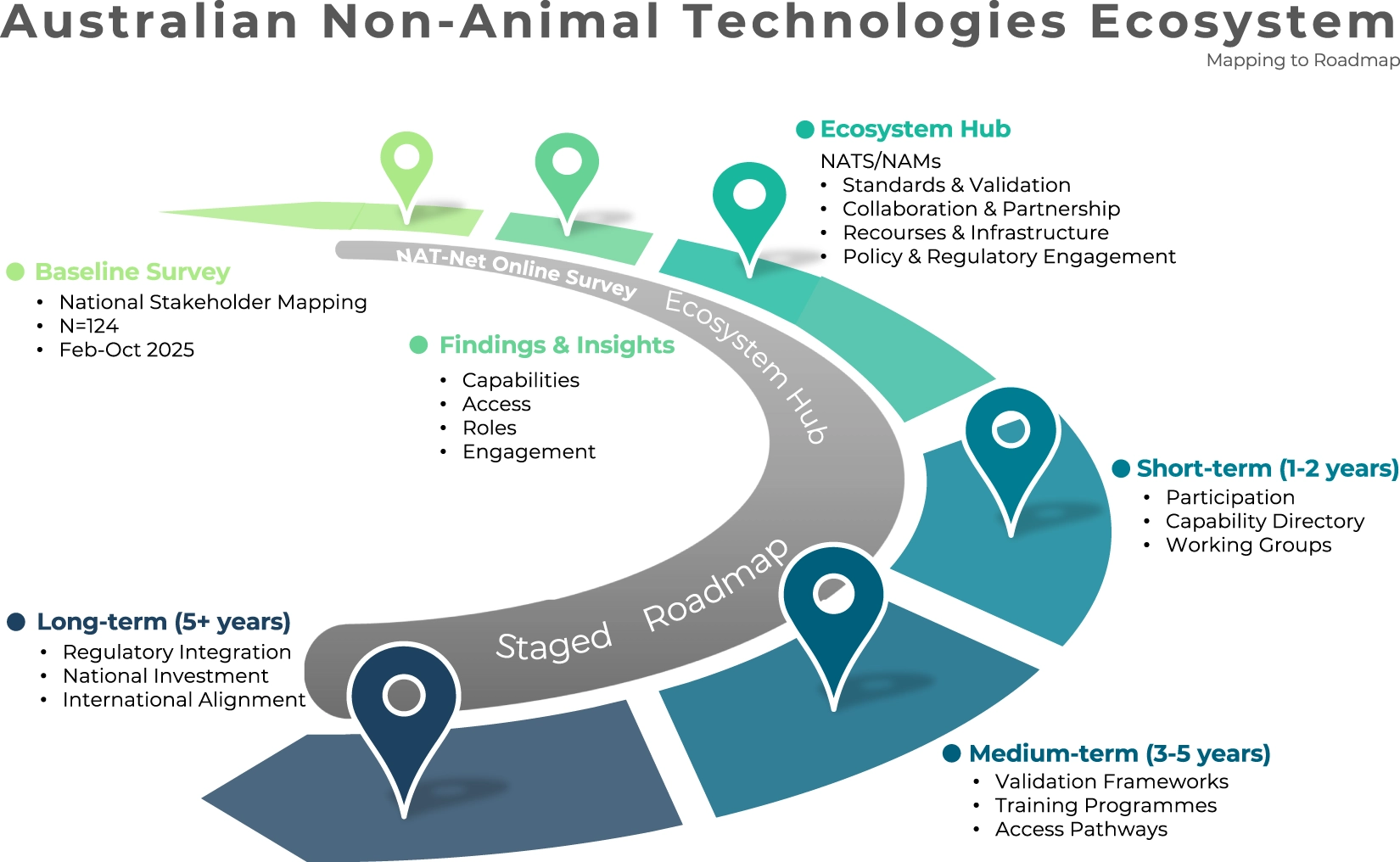
Short-term (1–2 years)
- Expand participation across underrepresented jurisdictions, sectors and technology areas
- Refine NAT categories and maturity descriptors
- Develop a secure, permissioned directory of national capabilities and infrastructure
- Establish working groups on standards, regulatory engagement and training
Medium-term (3–5 years)
- Co-develop validation frameworks, reference datasets and best-practice guidelines
- Build layered training and workforce development programs
- Strengthen access pathways to national infrastructure
- Pilot collaborative case studies of NAT integration in preclinical pipelines
Long-term (5+ years)
- Maintain a dynamic, longitudinal ecosystem map through periodic follow-up surveys
- Support integration of NATs into regulatory and policy frameworks
- Facilitate national coordination of investment in infrastructure and validation
- Promote international alignment and cross-border regulatory dialogue
Limitations
Key limitations include convenience sampling through early NAT-Net dissemination channels, which likely introduced sampling and geographic bias toward New South Wales-based and network-connected organisations. All data were self-reported and were not independently validated. The cross-sectional design provides a snapshot at a single time point in a rapidly evolving landscape, and infrastructure visibility is inherently unequal, so less formalised services may be underrepresented. The open dissemination strategy also meant a response rate could not be calculated, which limits inference about population representativeness.
Funding: This project was funded by NSW Health through the Non-Animal Technologies Network (NAT-Net) program. The views expressed are those of the authors and do not necessarily reflect those of NSW Health.
Conflict of interest: The authors declared that this work was conducted in the absence of any commercial or financial relationships that could be construed as a potential conflict of interest.
Source: Waters SA, Hill AP, Pronker ES, Kaiko GE, Lin G, Keely S, Collie L, Chrzanowski W and Gonzalez-Cordero A (2026) Building Australia’s non-animal technologies ecosystem. Front. Toxicol. 8:1790806. Distributed under the Creative Commons Attribution License (CC BY).
A. Survey submissions by month
Hover a point for the exact count
B. Organisation type
C. Respondents by jurisdiction
Hover a bar for the exact count
D. Roles in the NAT ecosystem
Multiple responses were permitted, so shares add to more than 100%